Architecture
runsheets is a small Ruby gem: a document model, an execution layer, a record writer, and a thin Sinatra app over them. The model has no dependency on Sinatra and is tested in isolation.
lib/runsheets.rb              requires the model; autoloads the web layer and CLI
lib/runsheets/
  config.rb                   layered settings (myway_config); config/defaults.yml holds the defaults
  front_matter.rb             YAML front matter splitter
  fences.rb                   finds fenced blocks, rewrites info strings
  block.rb                    a fenced block and the kind its flags ask for
  renderer.rb                 kramdown + rouge, wraps executable blocks
  step.rb                     one markdown file: front matter, body, html, blocks
  single_file.rb              splits a one-file runbook into preamble and ## sections
  runbook.rb                  a directory or a single file: steps, verify, rollback
  library.rb                  a directory tree of runbooks: folders, entries, READMEs, rescan
  search.rb                   full-text search over runbooks
  diff.rb                     line diff for drift between a record and the runbook
  expectation.rb              compares a block's output with its expect block, {{any}} wildcards
  redactor.rb                 replaces secret values in captured output
  execution.rb                one execution: state, pid, files, timing
  executor.rb                 spawns, pumps output through the redactor to the file and the log, reaps, times out, stops
  run_record.rb               run.json, run.md, blocks/; list, load, drift, closing status
  run.rb                      one runbook's run: inputs, executions, confirmation codes
  session_log.rb              session.log: tagged, levelled lines, echoed to the terminal
  session.rb                  the session: engineer, notes, the runs, session.json, ending
  web.rb                      Sinatra routes and the security checks
  pages.rb                    pure functions that build the HTML
  pages/chooser.rb            the library page: header, folder pane, runbook pane
  pages/tree.rb               the folder tree in the library page's left pane
  pages/search.rb             the search results page
  assets.rb                   inline CSS and JavaScript
  cli.rb                      option parsing and the bin/runsheets entry point
bin/runsheets
examples/directory_based_runbooks/hello/               a safe runbook; also the test fixture
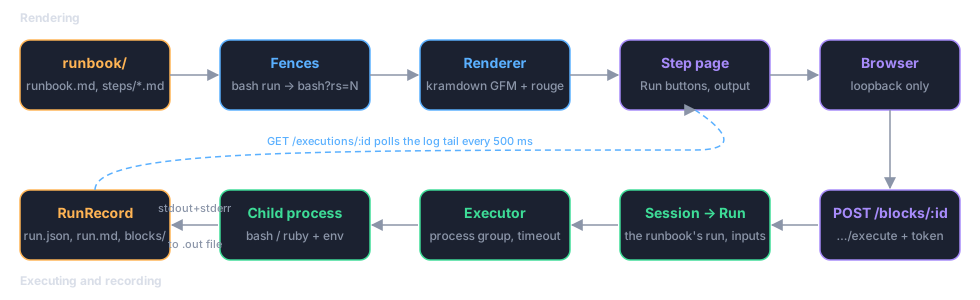
Rendering
The fence problem
kramdown's GFM parser accepts only a single word as a fence info string. "```bash run" is not a code block to it at all; the fence and its contents fall through as a paragraph. So the block convention cannot be read from kramdown's parse tree.
Fences.extract walks the markdown line by line, tracking open and close
fences (backtick or tilde, any length of three or more, up to three spaces
of indentation, matching the CommonMark rules closely enough for runbooks).
For each fence with an info string it records the info, the dedented code
and the line number, and rewrites the info string in the markdown to
lang?rs=N, where N is the fence's index. Bare fences are tracked, so
their contents are never mistaken for fences, but not recorded.
kramdown passes lang?opts through as the block's language (the form it
uses for Rouge options). Renderer::HtmlConverter, a subclass of
kramdown's HTML converter, overrides convert_codeblock: when it sees the
marker it strips it, restores the real language so Rouge highlights
correctly, lets the parent produce the highlighted <div>, and wraps the
result in the rs-block markup with the data attributes and toolbar the
page's JavaScript needs.
Because the marker travels inside kramdown's own data, blocks nested in list items are found and numbered correctly, and a fence kramdown decides not to treat as a code block simply renders unwrapped rather than desynchronising the numbering.
Syntax highlighting
Rouge, through kramdown's highlighter hook, with a small formatter subclass
that produces the <div class="highlight"><pre><code> wrapper the stylesheet
expects without using Rouge's deprecated legacy formatter. The Monokai dark
theme's CSS is inlined into every page.
Steps and the runbook
Step is one markdown file: it splits front matter, renders the body once
at load time, keeps the blocks, and computes its warnings. Runbook loads
runbook.md as a step with slug runbook, the numbered steps in sorted
order, and the optional extras, and exposes lookups: step(slug),
find_block(id), neighbors(step), interpreter_for(lang). Everything is
immutable after load; an edited runbook is loaded again as a whole (see
below).
Executing
Executor#start writes the code to the execution's .cmd path, opens the
.out path, and calls Process.spawn with the interpreter command plus the
.cmd path, pgroup: true, stdin from /dev/null, stdout and stderr to
the log. A reaper thread polls Process.wait2 with WNOHANG and the
timeout deadline; on expiry it signals the group with TERM, waits up to
two seconds, then KILL, and records the result as timed_out.
Execution is the state holder, mutated only by the executor through
started!, finished! and failed! under a mutex, and read by everyone
else. Its tee is the session log's output stream for that execution:
the pump thread writes each redacted chunk to the .out file and to the
tee, which turns it into > lines in the log. wait joins the reaper thread, which is how tests and the Ruby API
run a block synchronously.
Recording
RunRecord.start creates the run directory, named by the session id, and
writes the initial run.json. Executions are recorded as hashes the moment they are created,
before spawning, so the order in the record is the order of clicks. Live
Execution objects are kept alongside; refresh! copies their current
state into the hashes before any write. write! produces both run.json
and the run.md transcript from the same data.
RunRecord.load and RunRecord.list read records back for the history
panel and the /runs/:id page. A record also knows how to judge itself:
unresolved_failures lists blocks whose latest execution failed, and
drift compares each block's recorded .cmd with the runbook as it reads
now, using the small LCS diff in diff.rb.
The session reloads the runbook on screen whenever one of its markdown files changes on disk (checked on every GET), so a runbook can be edited while the server is up and the drift view compares against what is there now. Its run carries on with the fresh copy.
The session and its runs
Session is the engineering session: the engineer, the notes, the
runbook on screen, and a Run for each runbook selected, keyed by slug. It
writes session.json and owns the SessionLog. It is the only object the
web layer talks to; the calls that act on "this runbook" (execute,
mark_step, acknowledge, change_inputs) go to the run of the runbook
on screen, while stop and running look across every run. open(runbook,
inputs:) establishes a run or returns the existing one. end! closes
every run with RunRecord#closing_status. Building a session first calls
Session.close_interrupted, which closes sessions left running by a
process that is no longer alive on this host.
Run is one runbook's part of the session: its resolved inputs (secrets
included, kept in memory and never written), its redactor, its
RunRecord, its live executions by id, and the confirmation codes issued
for its destructive blocks. execute(block_id) does the checks (open run,
executable block, no blank referenced inputs), allocates file paths from
the record, builds the environment, logs the code, and hands off to the
executor. When an execution ends, the reaper thread logs how and rewrites
the record. A mutex in each serialises the state-changing calls.
SessionLog wraps two standard Loggers, one for the file and one for
the terminal echo, each with its own level and the same formatter.
The web layer
Web is a Sinatra::Base subclass with a before filter that enforces
the host and token checks, a handful of page routes that call into
Pages, and JSON endpoints to execute, acknowledge, poll and stop. Pages is a module of
pure functions from a session to HTML, so every page can be rendered in a
test without HTTP. Assets holds the CSS and JavaScript as strings; a
page is one self-contained response and the gem serves no static files.
The JavaScript is small and framework-free: sidebar toggle, outline, copy buttons, the execute-and-poll loop, restoring prior executions from a JSON blob the step page embeds, keyboard shortcuts, and on the library page the tree filter and cursor.
Web holds the session once it has started; before that its before
filter sends every page to the start page, and POST /session builds the
session with the options the CLI prepared. Started on a directory of
runbooks, Web also holds a Library. Library scans the tree once
(folders to any depth, a runbook directory being a leaf), keeps each
runbook loaded for the detail pane, and rescans when a folder or a
runbook file changes. Selecting a runbook (POST /runs) puts a freshly
loaded copy on screen and opens its run in the same session; the
runbook's slug is its path inside the library, so run records of
a/backup and b/backup never meet.
Testing
Minitest. The model classes are tested directly against the example
runbook and small generated runbooks in temporary directories; the executor
against real bash and ruby processes including a timeout; the record
against a temporary runs directory; and Web with rack-test, driving a
whole session from the start page to End session through HTTP.
Extension points
- Languages: the
interpretersfront matter, orBlock::INTERPRETERSfor defaults. - Executor:
Session.new(executor: ...)accepts anything responding tostart(execution, code:, env:, cwd:, redactor:)andstop(execution), which is how a test or an embedding application can intercept execution. - Pages: every page builder is a module function taking a session; an
embedding app can reuse
RendererandPagesor replace them.