Judgments
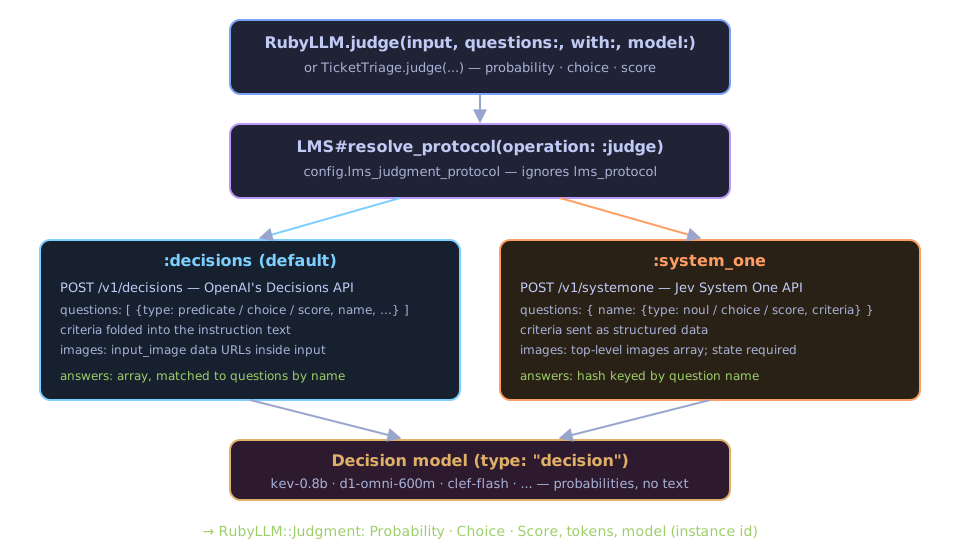
LM Studio 0.4.26 added two endpoints for decision models: models that
answer typed questions with probabilities instead of generating text. RubyLLM
2.1 calls this a judgment (RubyLLM.judge, RubyLLM::Judge), and this gem
points judgments at LM Studio.
A decision model reads the input once and answers every question with numbers. There is no output to parse and no format to coax, and it writes nothing — so it answers in milliseconds. On an M2 Max, D1 Omni 600M answers three questions about a support ticket in about 30 ms.
Three kinds of question
| Type | Ask it with | Answer object | What you read |
|---|---|---|---|
| probability | probability :name, 'question?' |
RubyLLM::Probability |
probability — the chance the answer is yes, 0 to 1 |
| choice | choice :name, 'question?' do ... end |
RubyLLM::Choice |
choice (a Symbol), probabilities per option, confidence |
| score | score :name, 'question?', levels |
RubyLLM::Score |
score (can fall between levels), levels, probabilities per level index, confidence |
One call can ask any number of questions; they all ride in a single request.
Ad hoc: RubyLLM.judge
review = <<~TEXT
  The blender arrived two days late, which was annoying. But it crushes ice in
  seconds, it is quiet, and smoothies come out perfectly smooth. Best kitchen
  purchase this year.
TEXT

judgment = RubyLLM.judge(
  review,
  questions: {
    satisfied: { type: :probability, instructions: 'Is the customer satisfied with the product?' },
    topic: { type: :choice, instructions: 'What is the review mostly about?',
             options: { shipping: 'Delivery speed or damage in transit', quality: 'How well the product works',
                        support: 'Dealing with customer service', price: 'Cost or value for money' } },
    sentiment: { type: :score, instructions: 'Overall, how does the customer feel about the product?',
                 levels: %w[Furious Unhappy Mixed Happy Delighted] }
  },
  model: 'd1-omni-600m', provider: :lms
)

judgment.satisfied.probability    # => 0.997
judgment.topic.choice             # => :quality
judgment.topic.probabilities      # => {shipping: 0.007, quality: 0.891, support: 0.011, price: 0.09}
judgment.sentiment.score          # => 3.95
judgment.sentiment.levels[judgment.sentiment.score.round]  # => "Delighted"
Numbers are model- and wording-specific
Every figure on these pages came from a real run on the author's machine.
Small decision models are sensitive to phrasing: shorten that review to
one sentence and D1 Omni 600M's satisfied drops from 0.997 to 0.18,
while Clef Flash barely moves. See Patterns and Tuning.
Question hashes take type:, instructions:, and the type's criteria key:
criteria: (yes/no descriptions) for a probability, options: for a choice,
levels: for a score.
Reusable: a RubyLLM::Judge subclass
Declare the questions once and run the judge over every record:
class TicketTriage < RubyLLM::Judge
  model 'd1-omni-600m', provider: :lms

  inputs :teams  # supplied per call; read by the lambda below

  probability :urgent, 'Does this need attention today?'
  choice :team, 'Which team should handle this?', -> { teams }
  score :frustration, 'How frustrated is the customer?', %w[Calm Annoyed Frustrated Angry]
end

judgment = TicketTriage.judge('The API has returned 500 errors for an hour!',
                              teams: { billing: 'Charges and refunds', technical: 'Bugs and outages' })
judgment.team.choice  # => :technical
RubyLLM's judgments guide covers the whole DSL: structured (Hash) input, blocks, dynamic options and provider options.
What a judgment carries
| Method | Returns |
|---|---|
judgment.<name> / judgment[:name] / judgment.fetch(:name) |
the answer for one question |
judgment.each { \|name, answer\| } |
every answer, in question order |
judgment.model |
the instance that answered (d1-omni-600m, or clef-flash:2 for a second instance) |
judgment.tokens |
input tokens; output is always 0 |
judgment.to_h |
model, answers, tokens and cost as plain data |
judgment.raw |
the HTTP response from LM Studio |
Judgments are instrumented as judgment.ruby_llm events, like chats.
Before you start
- You need LM Studio 0.4.26 or newer and a model LM Studio recognizes as a decision model. A chat model is refused. See Decision Models.
- Two endpoints serve judgments; the default is fine to start with. See Choosing the Endpoint — the choice matters more for small models than you might expect.
- Models with a vision adapter judge images too: Judging Images.
- Wording and thresholds are where the work is: Patterns and Tuning.