Architecture
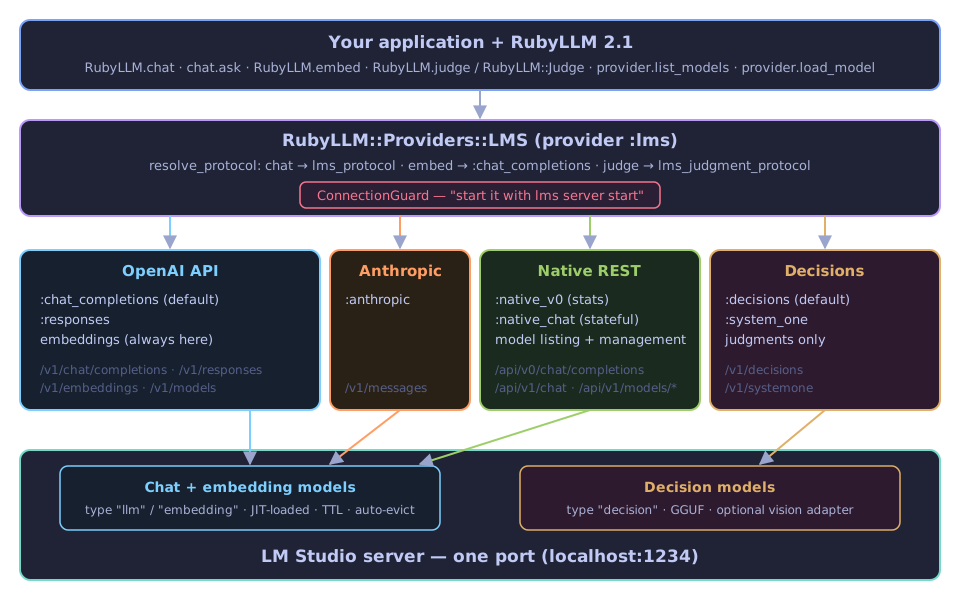
The gem is a single RubyLLM provider class, RubyLLM::Providers::LMS, with one
protocol class per LM Studio dialect. RubyLLM does the rest: chats, streaming,
tools, embeddings and judgments all run through RubyLLM's own machinery, and
the provider decides which LM Studio endpoint each one reaches.
Routing
RubyLLM asks the provider to resolve a protocol for every operation. The provider answers by operation, not just by configuration:
| Operation | Goes to | Chosen by |
|---|---|---|
chat (ask, streaming, tools) |
the chat protocol | lms_protocol, default :chat_completions |
| embed | :chat_completions → POST /v1/embeddings |
always — LM Studio serves embeddings nowhere else |
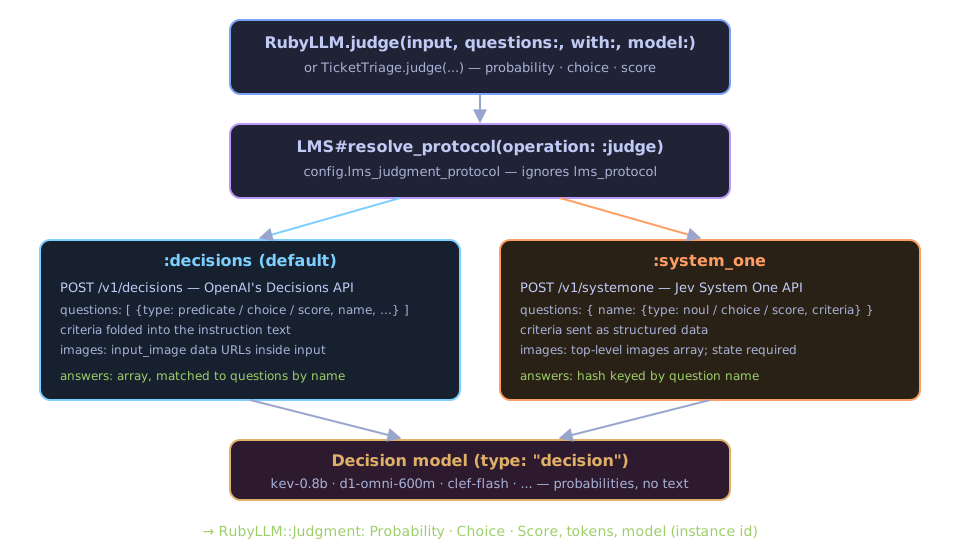
| judge | :decisions or :system_one |
lms_judgment_protocol, default :decisions |
| list models | :chat_completions, enriched from the native listing |
always — RubyLLM lists through the provider's default protocol, whatever lms_protocol says |
| load / unload / download | the provider's own ModelManagement methods |
— |
The judgment route is the provider's private resolve_protocol override: when
RubyLLM resolves with operation: :judge, it substitutes
lms_judgment_protocol. Without it, lms_protocol = :anthropic would send
judgments to a protocol that has none.
Source layout
| File | Responsibility |
|---|---|
lib/ruby_llm/providers/lms.rb |
The provider: protocol registry, API base and auth headers, embedding and judgment routing, configuration options; registers :lms with RubyLLM at load time |
lms/connection_guard.rb |
Wraps RubyLLM's connection so a refused connection raises a RubyLLM::Error telling you to run lms server start |
lms/models.rb |
Model listing: OpenAI /v1/models enriched with native details; capabilities, modalities and metadata |
lms/native_v1.rb |
Rewrites the native v1 listing into the shape models.rb reads, including reasoning options and decision fields |
lms/endpoints.rb |
Native listing paths, spelled relative to the /v1 base |
lms/responses.rb |
:responses — reads LM Studio's reasoning_text as well as OpenAI's summaries |
lms/anthropic_messages.rb |
:anthropic — RubyLLM's Anthropic protocol with LM Studio's path |
lms/native_chat.rb, native_chat/* |
:native_chat — stateful /api/v1/chat, with conversation continuation and streaming |
lms/decisions.rb |
:decisions — OpenAI Decisions, answers matched to questions by name |
lms/system_one.rb |
:system_one — System One with the /v1-relative path and image support |
lms/model_management.rb |
native_models, loaded_models, load_model, unload_model, download_model |
lms/version.rb |
RubyLLM::Providers::LMS::VERSION |
:chat_completions and :native_v0 are small classes defined in lms.rb
itself; :native_v0 is the Chat Completions protocol pointed at
/api/v0/chat/completions.
Design rules
- Everything lives in
RubyLLM::Providers::LMS. The gem adds no top-level constants.Archspec.rbenforces this, and that nothing underlib/references RSpec, WebMock or VCR. - Subclass RubyLLM, don't fork it. Each protocol is RubyLLM's stock protocol with the smallest override LM Studio needs — a path, a response field, a matching rule.
- Local means no ceremony.
configuration_requirementsis empty, so RubyLLM asks for no API key;local?is true, so it assumes any model id exists; the auth header is sent only whenlms_api_keyis set. - Paths are relative to the
/v1base. Native endpoints are reached as../api/v1/...so a non-defaultlms_api_basemoves everything together.