API Reference
Complete API documentation for HTM (Hierarchical Temporal Memory).
Overview
HTM is a two-tier intelligent memory management system for LLM-based robots:
- Working Memory: Token-limited active context for immediate LLM use
- Long-term Memory: Durable PostgreSQL storage with RAG-based retrieval
Class Hierarchy
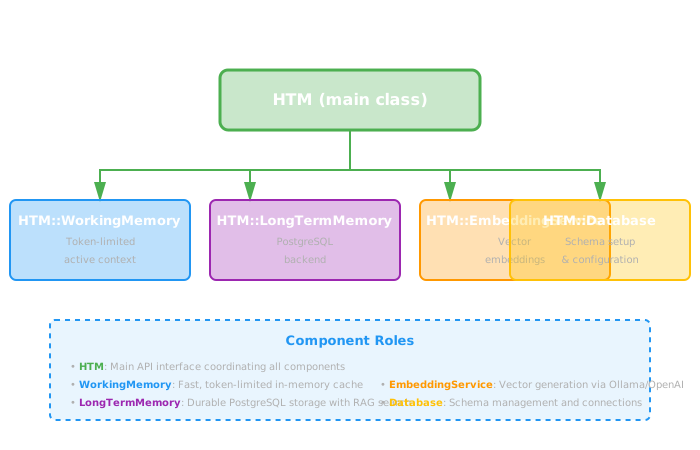
Class Diagram
Quick Reference
Core Classes
| Class | Purpose | Key Methods |
|---|---|---|
| HTM | Main interface for memory management | remember, recall, forget, restore, working_memory |
| WorkingMemory | Token-limited active context | add, evict_to_make_space, assemble_context |
| LongTermMemory | Persistent PostgreSQL storage | add, search, search_fulltext, search_hybrid |
| EmbeddingService | Vector embedding generation | embed, count_tokens |
| Database | Schema setup and configuration | setup, default_config |
Sequel Models
| Class | Table | Purpose |
|---|---|---|
HTM::Models::Node |
nodes | Core memory storage |
HTM::Models::Tag |
tags | Hierarchical tag names |
HTM::Models::NodeTag |
node_tags | Node ↔ tag join |
HTM::Models::NodeRelationship |
node_relationships | Weighted directed edges between nodes; Jaccard-similarity scores from tag co-occurrence |
HTM::Models::Robot |
robots | Robot registry |
HTM::Models::FileSource |
file_sources | Source file tracking |
Common Usage Patterns
Basic Memory Operations
# Initialize HTM
htm = HTM.new(robot_name: "Assistant")

# Add memories
htm.remember("PostgreSQL is our database",
  type: :fact, tags: ["database"])

# Recall memories
memories = htm.recall("PostgreSQL", timeframe: "last week")

# Create LLM context
context = htm.working_memory.assemble_context(strategy: :balanced)
Multi-Robot Collaboration
# Find who discussed a topic
robots = htm.which_robot_said("deployment")
# => {"robot-123" => 5, "robot-456" => 3}

# Get conversation timeline
timeline = htm.conversation_timeline("deployment", limit: 20)
Advanced Retrieval
# Vector similarity search
memories = htm.recall(
  "API design decisions",
  timeframe: "last 30 days",
  strategy: :vector,
  limit: 10
)

# Hybrid search (fulltext + vector)
memories = htm.recall(
  "security vulnerabilities",
  timeframe: "this month",
  strategy: :hybrid,
  limit: 20
)
Memory Management
# Get statistics
stats = htm.memory_stats
# => { total_nodes: 1234, working_memory: { current_tokens: 45000, ... }, ... }

# Explicitly forget
htm.forget("temp_note", confirm: :confirmed)
Search Strategies
HTM supports three search strategies for recall:
| Strategy | Description | Use Case |
|---|---|---|
:vector |
Semantic similarity using embeddings | Find conceptually related content |
:fulltext |
PostgreSQL full-text search | Find exact terms and phrases |
:hybrid |
Combines fulltext + vector | Best of both worlds - accurate and semantic |
Memory Types
When adding nodes, you can specify a type:
| Type | Purpose |
|---|---|
:fact |
Factual information |
:context |
Contextual background |
:code |
Code snippets |
:preference |
User preferences |
:decision |
Architectural decisions |
:question |
Questions and answers |
Context Assembly Strategies
When creating context with working_memory.assemble_context:
| Strategy | Behavior |
|---|---|
:recent |
Most recently accessed first |
:frequent |
Most frequently accessed first |
:balanced |
Weighted by access frequency and recency |
API Documentation
- HTM - Main class reference
- WorkingMemory - Active context management
- LongTermMemory - Persistent storage
- EmbeddingService - Vector embeddings
- Database - Schema and configuration
Error Handling
HTM raises standard Ruby exceptions:
# ArgumentError for invalid parameters
htm.forget("key")  # Raises: Must pass confirm: :confirmed

# PG::Error for database issues
htm.add_node("key", "value")  # May raise PG connection errors

# Invalid timeframe
htm.recall(timeframe: "invalid")  # Raises ArgumentError
Thread Safety
HTM is not thread-safe by default. Each instance maintains its own working memory state. For multi-threaded applications:
- Use separate HTM instances per thread
- Or implement external synchronization
- Database connections are created per operation (safe)
Performance Considerations
- Working Memory: O(n) for eviction, O(1) for add/remove
- Vector Search: O(log n) with proper indexing
- Fulltext Search: O(log n) with GIN indexes
- Hybrid Search: Combines both overhead
For large memory stores (>100K nodes):
- Use hybrid search with appropriate
prefilter_limit - Purge soft-deleted nodes periodically with
htm.purge_deleted - Add partial indexes for frequently filtered columns
Next Steps
- See HTM class reference for detailed API
- Review examples for common patterns
- Check database schema for advanced queries